Two AI hosts, Alex and Jordan, discuss the study’s key findings, its limits and what it could mean for classrooms.
Alex: We’re AI voices, and this episode discusses an article from the USF College of Education Newsletter. The study we’re talking about is by Jenifer Jasinski Schneider, James R. King, Deborah Kozdras, and James L. Welsh, and it looks at how students move between fast and slow literacies when they make films.
Jordan: Fast and slow literacies sounds interesting, but what does that actually mean in this study?
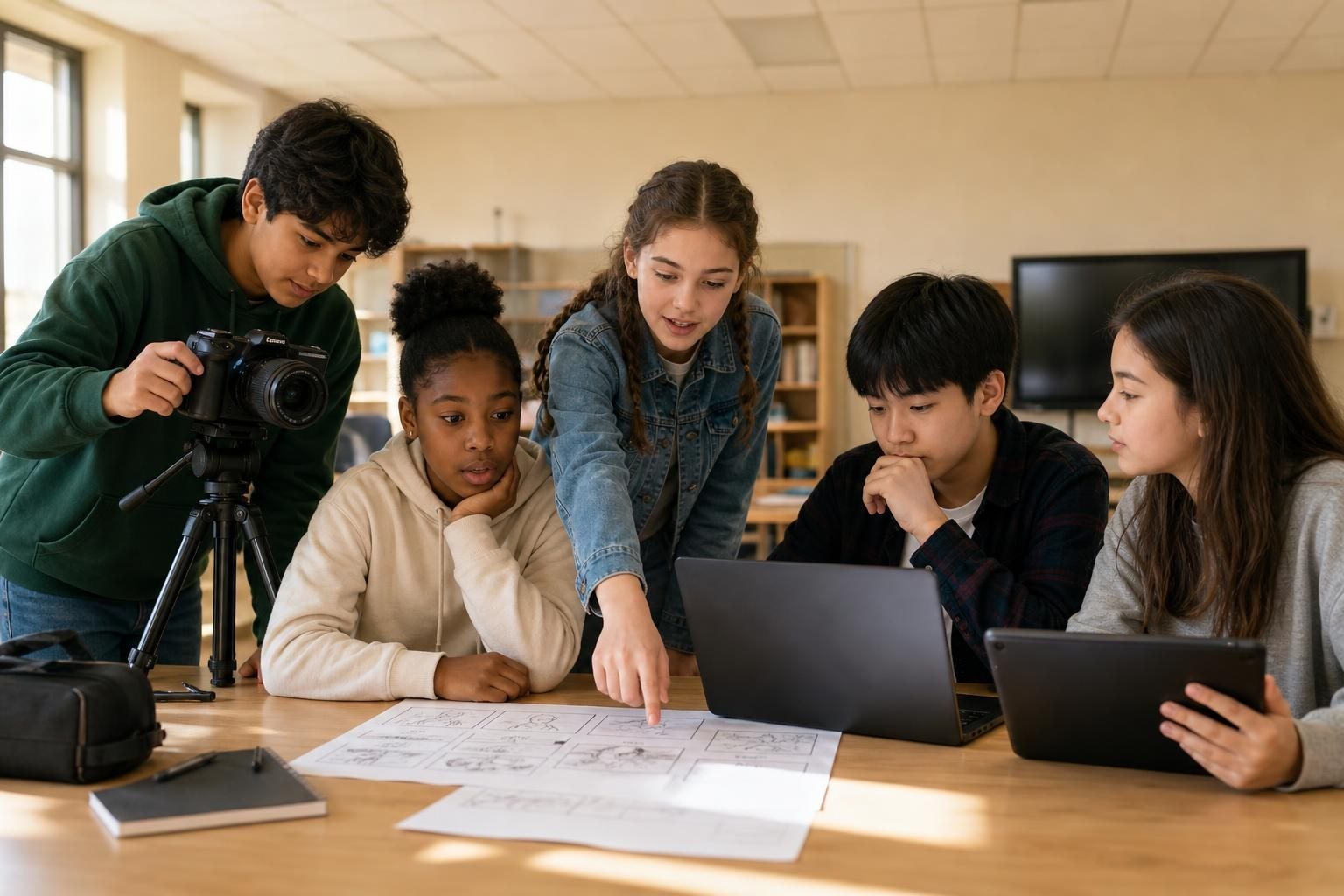
Alex: The researchers used fast literacies to describe quick cultural recognition, like spotting memes, pop culture references, familiar stories, and shared jokes. They used slow literacies for the more deliberate work of filmmaking, such as storyboarding, scripting, camera work, lighting, sound, editing, and revision. Their main point was that film composing was not just quick digital play; it moved back and forth between fast idea-making and slow technical work.
Jordan: So what did they actually study?
Alex: They used a cross-study comparison of student filmmaking across two settings. One was a writing methods course with field experiences for Grades 3 to 6, and the other was a summer movie camp with Grades 3 to 12. Across about 10 years, they say roughly 250 films were created in the field experiences and about 800 in the summer camp. For this article, they worked with 44 films that had more extensive observational data, and then focused in detail on four films.
Jordan: What kinds of data did they use for those 44 films?
Alex: They drew on video observations, transcripts, observation notes, interviews, and final products. They also reviewed timelines and transcript quality, and they kept only the films that gave them enough traceable detail for the questions they were asking. That matters because this was a qualitative pooled case comparison, not a controlled experiment.
Jordan: What did they find that would matter to teachers?
Alex: One key finding was that fast ideas often had to slow down before they could become a workable film scene. In one example from the summer camp, a Chuck Norris meme sparked quick energy in the group, but turning that idea into a stop-motion sequence required retakes, rewrites, and special effects work that took about 45 minutes. The researchers found that idea generation could be rapid, but production still demanded planning, technical knowledge, and repeated revision.
Jordan: So a quick idea is not the same thing as a finished product?
Alex: Exactly. The article argues that youth could quickly connect to cultural symbols, but they still had to do the slower work of making those ideas filmable. The researchers saw that this slowing down happened in several phases, not just one place in the process. Brainstorming could be fast, but so could some scriptwriting moments; editing often required especially purposeful attention.
Jordan: Did audience awareness help students make stronger films?
Alex: Not always. The researchers found that students often tried to make films funny or memorable by using inside jokes or popular references, but those choices sometimes worked against the assigned topic. In one classroom example, third-grade students filled a storyboard with hamster jokes and movie references, but the film no longer matched the teacher’s goal of explaining a Mexican holiday. So knowing the audience did not automatically produce a better product.
Jordan: That seems important for classroom work. What does that mean for teachers?
Alex: It suggests that teachers cannot assume students will naturally stay aligned with a task just because they are engaged. The study shows that engagement, humor, and cultural references can be useful starting points, but students may need guidance to connect those ideas to the purpose of the assignment. In other words, audience awareness has to be shaped toward the rhetorical goal.
Jordan: What else did the researchers find about how students learn from filmmaking?
Alex: They found that film knowledge is layered. Students learned to make meaning through scripts, camera angles, lighting, sound, gestures, and editing, and they also became better at reading other films after making their own. The authors say this creative deconstruction helped students notice how videos produce emotional responses and how images can be manipulated.
Jordan: Why does that matter beyond film class?
Alex: The researchers connect it to the broader media environment, including concerns about deepfakes and fake news in a post-truth era. Their point is not that filmmaking solves those problems, but that learning to unpack and remake media may help students understand how visual messages are built and how they can be misleading. That is why they frame filmmaking as a way to teach both communication and critical awareness.
Jordan: Did they say students became better at spotting manipulation?
Alex: They suggested that direct teaching of film processes could break down the visual and create insider knowledge of how films are made. For example, students learned that they could create effects through camera tricks, green screens, lighting, sound, or voice-over, even when something did not literally happen in front of the camera. The researchers describe this as helping students see that what you see is not always what you get.
Jordan: What about limitations? I want to know what educators should not overgeneralize.
Alex: The authors are careful here. Because the study is a qualitative cross-case comparison, they do not claim universal effects. The work is based on a particular set of contexts: university-linked field experiences and a local summer movie camp. Also, the film sample used for detailed analysis was narrowed to 44 films with stronger observational records, and then to four films for close discussion, so the findings come from selected cases rather than from every film created.
Jordan: So we should not treat the results like a one-size-fits-all rule?
Alex: Right. The study supports careful interpretation, not sweeping conclusions. It shows patterns across those settings, but the authors do not claim that all students everywhere will respond the same way, or that filmmaking automatically improves literacy in the same way in every classroom. The article is about possibilities and processes, not a universal formula.
Jordan: How might this inform practice without overstating it?
Alex: Carefully, it can remind teachers, teacher educators, and school leaders that multimodal composing involves both social meaning and technical design. The authors suggest that students may need explicit teaching of film language, including available designs such as shots, angles, lighting, music, sound, and editing. They also suggest that teachers can use filmmaking to help students develop vocabularies and processes for thoughtful communication across formats.
Jordan: Does the study say anything about why teachers and teacher educators should pay attention?
Alex: Yes. The authors argue that if educators understand the design grammars students already use, and the social contexts those products come from, they can better support purposeful composing. They also say that teaching students to unpack media can give them access to the strategies and processes needed for active, thoughtful communication. That is especially relevant when students are already working with digital media in everyday life.
Jordan: What would you say is the big takeaway in plain terms?
Alex: The big takeaway is that student filmmaking is both quick and slow at once. Students may move fast when they recognize memes or familiar cultural material, but they still need deliberate work to turn those ideas into meaningful films. The researchers found that this back-and-forth can support deeper understanding of media, audience, and communication.
Jordan: So the summary is: fast ideas matter, but they need slow craftsmanship, and teachers should guide that process carefully?
Alex: Exactly. This study suggests that filmmaking can be a productive way to teach literacy as both social communication and technical design, while also helping students think critically about media. To read more, check out the full article on the USF College of Education Newsletter website.