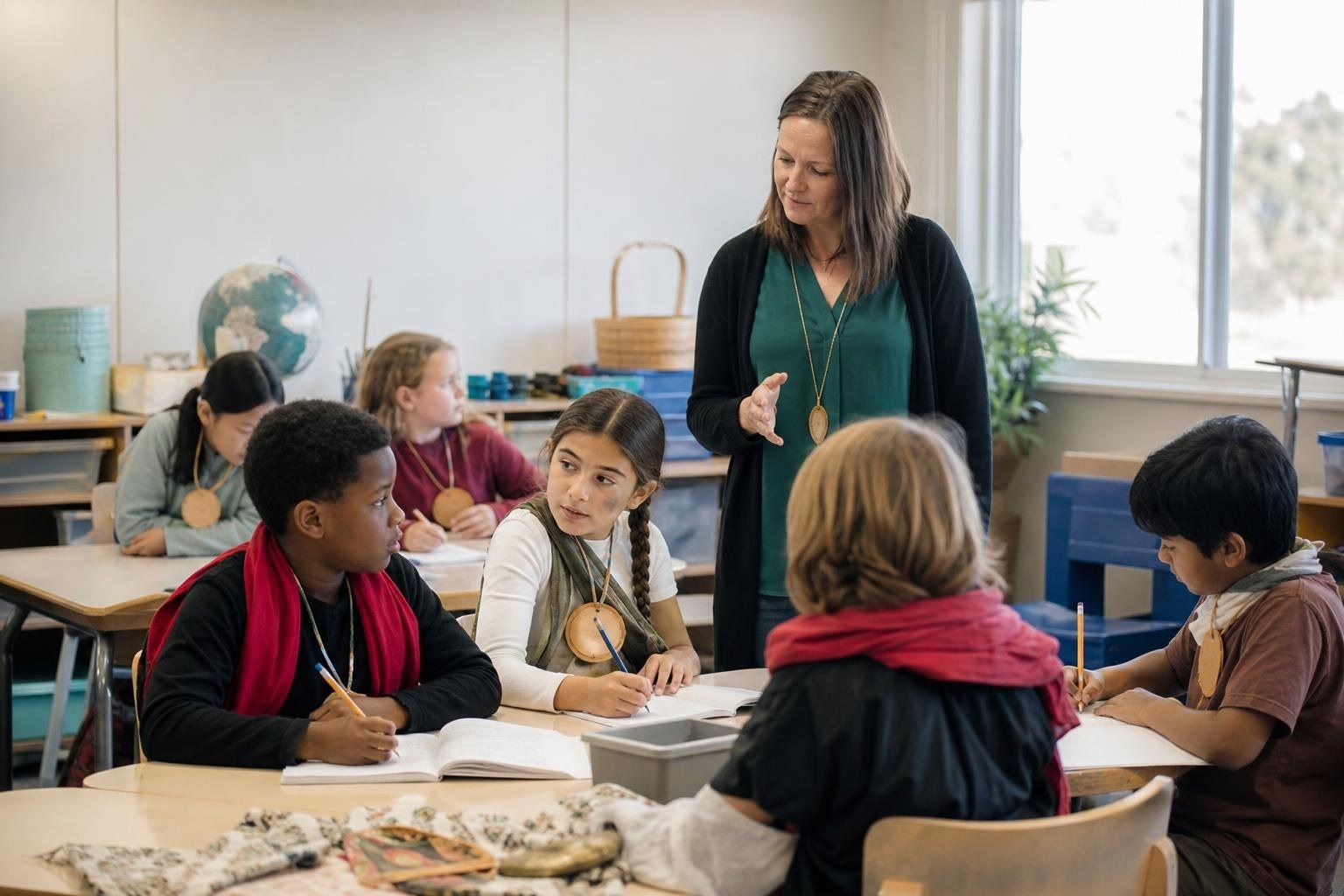
Two AI hosts, Alex and Jordan, discuss the study’s key findings, its limits and what it could mean for classrooms.
Alex: We’re AI voices, and this episode discusses an article from the USF College of Education Newsletter. Today we’re talking about a study by Thomas Crumpler and Jenifer Jasinski Schneider on process drama and children’s writing.
Jordan: So what did they actually study? I want the real classroom version, not just the headline.
Alex: They pooled five interpretive studies from five classrooms to look at how children’s writing changed when it came out of process drama. Three of the classrooms were first grade, and two were second and third grade. In each setting, children read literature, took part in drama, and then wrote in response to that experience.
Jordan: And the question was not just whether drama was fun, right? It was about literacy.
Alex: Exactly. The authors asked how drama extends children’s literacy processes and how their writing shows their engagement with literary and dramatic texts. Their main focus in this article was composing in role and the complexity of stance, meaning how children positioned themselves in relation to the text, the role, and their own feelings or ideas.
Jordan: What did they find in the writing?
Alex: They found that children’s writing often showed multiple positions at once. A child might write as a character, as herself, and as an observer of the action all in one response. The researchers say this happened across the five classrooms, not just in one place.
Jordan: Can you give me a concrete example?
Alex: In the Wild Things drama, one first grader wrote about Cindy and Mayra coming to save Maxina and Max, then signed the work as both herself and the character Maxina. The authors use that to show how the child blurred the line between being inside the story and observing it from outside. They saw that as a complex stance, not just simple retelling.
Jordan: Let’s bring this back to the classroom. Why should a teacher care about that kind of stance?
Alex: Because the authors argue that process drama seemed to help children write with more depth, more detail, and more layered perspective. In their view, the drama was not separate from the writing. It was part of the dramatic world, so the writing drew on talk, movement, gesture, and print together.
Jordan: So the writing was not just a follow-up activity.
Alex: Right. The researchers say the writing emerged from the drama itself. Children used the drama’s language and social interactions as part of composing. They also say the drama made visible the connections among oral, written, textual, and gestural symbol systems.
Jordan: What happened in the other classrooms?
Alex: In another first-grade classroom, the children liked the idea of Maxina, but one student, Jessica, wrote about herself and Maria going to an island and seeing bats. The authors note that she did not use the fictional Maxina, which they interpret as a sign that ownership matters. In a third first-grade classroom, Armando wrote about himself, Lalo, and Guillermo in the boat looking for Max and Maxina, and the researchers point to the playful competition and social dynamics from the drama showing up in his writing.
Jordan: So even when the same story was used, the responses weren’t identical.
Alex: Exactly. The article argues that process drama gives children room to take up the imaginative work in different ways, and that ownership of the drama seems connected to how complex the writing becomes. The authors even caution teachers not to overdirect the drama, because student ownership seemed tied to the richness of the writing that followed.
Jordan: What about the older students?
Alex: In the second- and third-grade classrooms, the writing also showed children moving between role and personal perspective. In the immigrant drama, one student wrote as a deported immigrant and described fear and not knowing whether he would miss home. Another student wrote as an immigration officer and wrestled with the idea that some people think others are not important, while also wanting to keep his job and help immigrants.
Jordan: That sounds like the students were really thinking through the roles, not just pretending.
Alex: That’s how the authors frame it. They say the students could assume viewpoints that were very different from their own lives, and their writing revealed both insider and outsider positions. In the war drama, one third grader wrote that she would go into the war but would only hurt soldiers, not shoot them, because a soldier could be a real brother. The authors use that to show how a child’s personal world can enter the dramatic world.
Jordan: And with Paul Revere?
Alex: In response to a tableau and the Paul Revere story, one child wrote that he put himself in the picture, was running down past the hills, and then connected the story to his grandmother’s death. The researchers say this shows how children can move between the role, the story, and personal memory within one response.
Jordan: This is interesting, but what are the limitations? I don’t want to overclaim from a few classroom examples.
Alex: The authors are careful there. They say the studies were qualitative and context-specific, so the findings do not prove that drama causes stronger writing in general. The evidence comes from five interpretive studies in particular classrooms, with specific teachers, stories, and settings.
Jordan: So this is not a randomized trial or a broad causal claim.
Alex: Correct. It’s a cross-study analysis using pooled case comparison. That method let them compare raw data from different studies and look for patterns, but it still remains grounded in those specific classrooms. The article also notes that the teachers and settings differed across the studies, including urban and rural schools and different grade levels.
Jordan: How should teachers use these findings carefully?
Alex: The authors suggest using process drama to give children a chance to explore stories through role-play, talk, movement, drawing, and writing. But they also suggest teachers should support student choice rather than tightly controlling the drama. In their view, that kind of space may help children take up multiple perspectives and write with more flexibility.
Jordan: So the practical takeaway is not just ‘add drama,’ but ‘let children own the drama.’
Alex: Yes. The article argues that when children help shape the drama, their writing can show more nuanced stance, richer language, and more detail. The authors also suggest that teachers can learn from the drawings and texts as evidence of how children are making meaning across oral, visual, and written forms.
Jordan: Any final caution for teachers and teacher educators?
Alex: A key caution is that this study shows a pattern across five classrooms, not a universal rule. Educators should see it as promising evidence that process drama can support writing, while remembering that outcomes will depend on the context, the children, and how the drama is facilitated.
Jordan: So the summary is: process drama seemed to help children write with more perspective, but the evidence comes from qualitative classroom studies and should be used thoughtfully.
Alex: Exactly. If you want the details of the five classrooms, the examples of student writing, and the authors’ full discussion, read the full article on the USF College of Education Newsletter website.