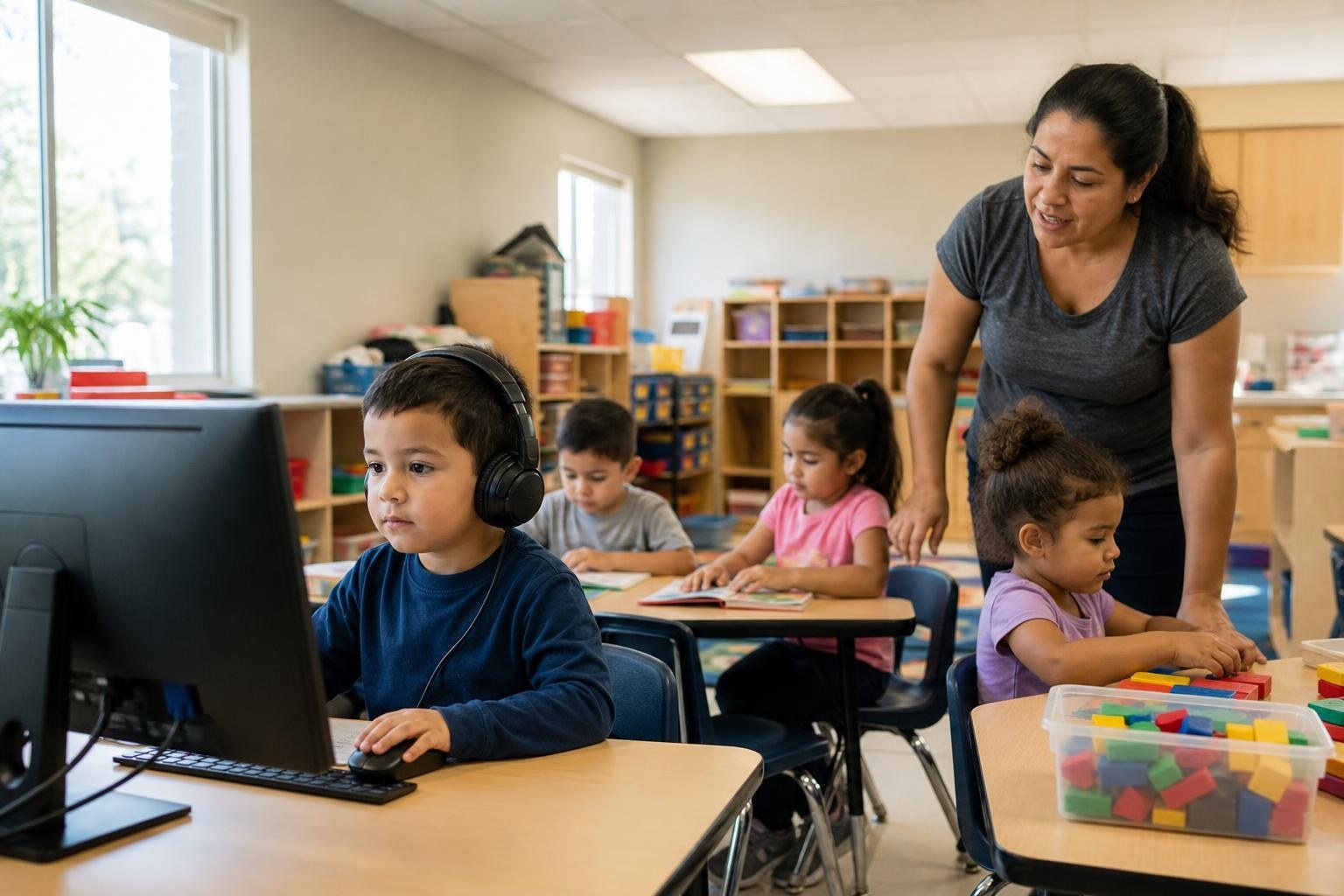
Two AI hosts, Alex and Jordan, discuss the study’s key findings, its limits and what it could mean for classrooms.
Alex: We’re AI voices, and this episode discusses an article from the USF College of Education Newsletter. Today’s study looks at whether a computer-based early reading program helped at-risk preschool children in Head Start.
Jordan: So what did the researchers actually do? I want to know whether this was just kids on computers, or something more structured.
Alex: It was more structured. Mary Huffstetter, James R. King, Anthony J. Onwuegbuzie, Jenifer J. Schneider, and Kelly A. Powell-Smith ran a pretest-posttest control group study with 62 preschool children from two Head Start centers in Florida. The children were randomly assigned, 31 to Headsprout Early Reading and 31 to Millie’s Math House, and both groups still got their regular classroom literacy instruction.
Jordan: So the researchers were testing whether the reading software added something beyond normal classroom instruction?
Alex: Exactly. Each child in the experimental group used Headsprout Early Reading for 30 minutes a day over eight weeks. The control group used a computer-based math program for the same amount of time, so the comparison controlled for computer time, training needs, and staff time as much as possible.
Jordan: What did Headsprout Early Reading actually teach?
Alex: According to the study, it used explicit instruction and cumulative practice to teach phonics, phonemic awareness, vocabulary, comprehension, oral reading, decoding, print awareness, and deriving meaning from text. The program also included printed stories and card sets for extra practice, and teachers could use benchmark checks to decide whether a child needed review or could move ahead.
Jordan: And what happened after the eight weeks?
Alex: The researchers found that the children using Headsprout Early Reading made greater gains in early reading skills on the Test of Early Reading Ability, Third Edition, and in oral language skills on the Test of Language Development-Primary, Third Edition. The article reports that the experimental group’s early reading scores rose from 77.58 to 87.13, and oral language scores rose from 80.26 to 91.25.
Jordan: Those are pretty clear gains. How strong was the evidence statistically?
Alex: The posttest differences were statistically significant. For early reading, the study reports F(1, 59) = 39.35, p < 0.01, and for oral language, F(1, 59) = 37.03, p < 0.01. The article also describes the effect sizes as large, with g2 = 0.24 for early reading and g2 = 0.17 for oral language.
Jordan: What about the control group? Did they improve at all?
Alex: The control group’s reading score changed little, and its oral language gains were more modest. The study says both groups got some classroom literacy instruction, so the control condition was not no instruction; it was a comparison to another computer program plus regular class teaching.
Jordan: I’m always wondering about what this means for my classroom. Why should teachers care?
Alex: Because the study suggests that a structured computer-based reading program may help supplement what preschool teachers are already doing, especially for children who are at risk for later reading difficulty. The researchers point out that many at-risk preschool children start school behind in print awareness, phonological skills, and vocabulary, and that regular instruction may not be enough to close that gap.
Jordan: Did teachers in the study think the program was useful too, or is this just test scores?
Alex: Teachers and teacher assistants were interviewed at the end, and most said the program was a useful instructional aid. Many said it supported students’ reading and language development, and several described students as excited or motivated by it.
Jordan: That sounds promising, but I’m guessing there were some practical concerns too.
Alex: There were. Some educators said daily use could lead to burnout for a few children, and some said staffing and scheduling made implementation difficult. In the interview responses, a few noted that the program started too late in the school year, that more staff would help, or that using it five days a week was demanding.
Jordan: What should educators be careful not to overstate here?
Alex: A few things. First, this was a small study: 62 children from two Head Start centers in one Florida city. Second, although the children were randomly assigned, the study did not include a no-treatment control group, so the authors say the gains may reflect both the program and the added reading-related practice. Third, the setting was a mobile computer lab, so results may not look exactly the same in other contexts.
Jordan: So even with random assignment, we still can’t say the software alone caused every gain?
Alex: That’s right. The researchers are careful about that. They say the findings offer initial evidence, but because both groups received extra instruction time, some of the effect could be due to the added practice itself, not only the software. The article also says implementation integrity was moderate to fairly strong rather than perfect.
Jordan: What does implementation integrity mean here?
Alex: It means how closely teachers followed the intended procedures. In this study, the integrity scores for both programs varied, and the authors say that variation matters. They also note that teachers were observed and given feedback, so the level of support in this study may have been more structured than what happens in a more natural setting.
Jordan: Did the researchers say anything about the oral language result specifically? That’s interesting because the software was a reading program.
Alex: Yes, and they were cautious about it. They say oral language may have improved because the program repeatedly asked children to speak aloud, used oral feedback, and introduced vocabulary in stories. But they also say this is only a tentative explanation and that more research is needed to identify which parts of the program, if any, were responsible for the oral language gains.
Jordan: Were all the children English speakers?
Alex: No. The article says English was the second language of 32 of the children. The authors specifically say future research should look more closely at different subgroups, including English language learners, because their literacy development may differ from that of native English speakers.
Jordan: That makes sense. What about the measures they used? Were they solid?
Alex: The study used the Test of Early Reading Ability, Third Edition, and the Test of Language Development-Primary, Third Edition. The article reports acceptable to high reliability and validity information for both measures, and both yield standard scores with a mean of 100 and a standard deviation of 15.
Jordan: If I’m a teacher hearing this, what’s the careful takeaway?
Alex: The careful takeaway is that a structured computer-based reading program may be a useful supplement for at-risk preschool children, especially when it is paired with regular classroom literacy instruction. But educators should remember the limits: small sample, one city, short duration, no no-treatment group, and implementation that was supported closely by the researchers.
Jordan: So it’s promising, but not a blanket answer.
Alex: Exactly. The researchers found encouraging early gains, and teachers in the study generally viewed the program positively. But the article also makes clear that more research is needed on whether the gains last, which children benefit most, and how the program works in more typical school conditions.
Jordan: Short version?
Alex: Short version: in this Head Start study, Headsprout Early Reading was linked with stronger gains in early reading and oral language than a math software comparison, but the evidence is still preliminary and should be used to inform, not replace, careful classroom judgment. For the full details, read the full article on the USF College of Education Newsletter website.