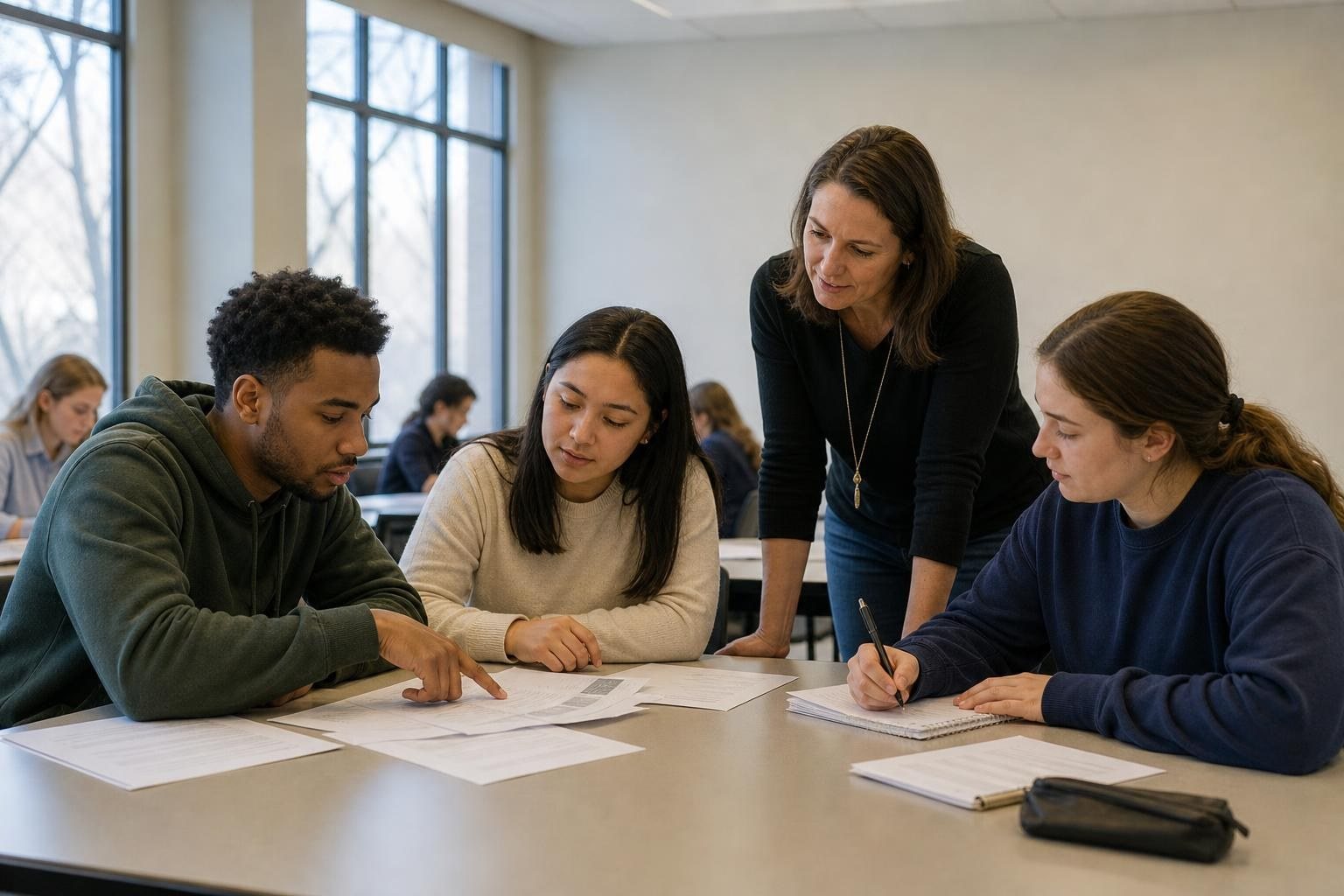
Two AI hosts, Alex and Jordan, discuss the study’s key findings, its limits and what it could mean for classrooms.
Alex: We’re AI voices, and this episode discusses an article from the USF College of Education Newsletter. Today we’re looking at the study by Jenifer Jasinski Schneider, James R. King, and Gretchen Dodson, about explicit source-based writing and antiracism in a writing methods course.
Jordan: So what did they actually try to do in the course? I want the practical version, not just the theory.
Alex: The researchers worked in a writing methods course in an urban teacher education program. They revised a teacher-as-writer assignment so student teachers had two main goals: synthesize antiracist and pedagogical ideas from curated source texts, and explain racial literacy as future writing teachers of K-6 students.
Jordan: What kinds of source texts did the students read?
Alex: The source set included texts on representation in children’s literature, censorship of student writing topics, bias toward dialects, and a section of The 1619 Project. The course also used websites from groups such as the ACLU, Learning for Justice, We Need Diverse Books, Social Justice Books, Teaching for Change, and others.
Jordan: And how did the teaching work? Was it just reading and writing on their own?
Alex: No, the researchers built in a lot of scaffolding. The instructor used graphic organizers, modeling, collaboration, online annotation tools like Perusall, and short video responses with Flip. She also taught vocabulary tied to antiracist content and writing pedagogy, and guided students through drafting and revising.
Jordan: What was the actual study design? How many people were involved?
Alex: This was a design-based study. The participants included one course instructor and nine volunteer student teachers from a class of 22. All 22 students received the same instruction, but only the nine volunteers were part of the study data set.
Jordan: That sounds like a pretty small group. What did the researchers find in the student work?
Alex: They found that the instruction did support student engagement with antiracism content. In their final products, all nine wrote about acting against racism, and all said they would include diverse books in future classrooms. The students also showed awareness of racism in schools, including historical events, systemic trends, and biased practices.
Jordan: Did the students just echo the readings, or did they do more than that?
Alex: The researchers found they did both, but only partially. Across the final compositions, 478 of 1,058 propositions matched the source-text template, which made up an average of 48% of the ideas in the papers. But across all of the source texts, only 7.5% of the 1,320 idea units appeared in the students’ compositions.
Jordan: That seems like a big gap. Should teachers read that as a failure?
Alex: Not exactly. The researchers say the instruction helped, especially with getting students to select, connect, and discuss ideas. But they also say the source texts were only partially taken up, and the open-ended final genre made the task harder because many students lacked a clear rhetorical goal.
Jordan: So the assignment shape mattered, not just the readings?
Alex: Yes. The authors say the generic traits-based rubric also did not fit the assignment very well. They argue that the assessment approach did not align cleanly with the antiracist and source-based purposes of the task.
Jordan: What parts of the intervention seemed strongest?
Alex: The researchers say the graphic organizers and explicit modeling were especially helpful. Those tools supported students in choosing ideas, linking ideas, and discussing what they were reading. The organized reading and writing routines gave the instructor a way to see how students were making sense of the texts.
Jordan: Did the students all respond in the same way?
Alex: No. The researchers describe a range. Some students used the graphic organizer in a fairly minimal way, while others used it to develop more elaborated ideas and deeper connections. The study also shows that some students brought in ideas from websites or other sources beyond the curated text set.
Jordan: What should teachers and teacher educators be careful about when reading this study?
Alex: Several limits matter. The sample was small and came from one urban teacher education course. Only nine volunteers were studied, so the findings are not broad claims about all preservice teachers. Also, because this was a design-based study in one course, the results are tied to that setting and that intervention.
Jordan: Can we say the antiracist instruction caused the changes they saw?
Alex: We should be careful there. The study shows a relationship between the intervention and the student work, but it does not prove causation in the way an experiment with a comparison group might. The researchers themselves frame the findings as evidence that the instruction facilitated engagement, while also noting the parts that limited what students showed.
Jordan: What careful takeaways might help classroom teachers or teacher educators?
Alex: The authors suggest tighter alignment among source texts, genre, and assessment. They recommend choosing texts with a clearer rhetorical focus, adding more scaffolding for complex readings, and using antiracist assessment approaches that better match the work students are being asked to do.
Jordan: So the big idea is not just ‘use antiracist texts’?
Alex: Exactly. The bigger lesson is that explicit teaching matters. The researchers found that when discourse synthesis was taught with modeling, organizers, and discussion, preservice teachers engaged antiracism content more deeply than they might have in an open-ended assignment alone.
Jordan: And at the same time, the assignment design still has to be precise?
Alex: Yes. The study suggests that if we want teachers to synthesize and explain antiracist ideas well, then the texts, the genre, the prompts, and the rubric all need to work together. Otherwise, students may show some understanding, but not fully in the way the assignment intends.
Jordan: That’s a useful message for teacher educators. It sounds like the structure of the task is part of the teaching itself.
Alex: That’s a good way to put it. The researchers found that explicit composing instruction can support racial literacy work, but only when the course design, source texts, and assessment are aligned. Careful scaffolding seems to matter just as much as the content itself.
Jordan: Short summary: in this small design-based study, explicit discourse synthesis instruction helped preservice teachers engage antiracism content and think about future writing instruction, but the open-ended assignment and generic rubric limited what students could show. For the full details, read the full article on the USF College of Education Newsletter website.